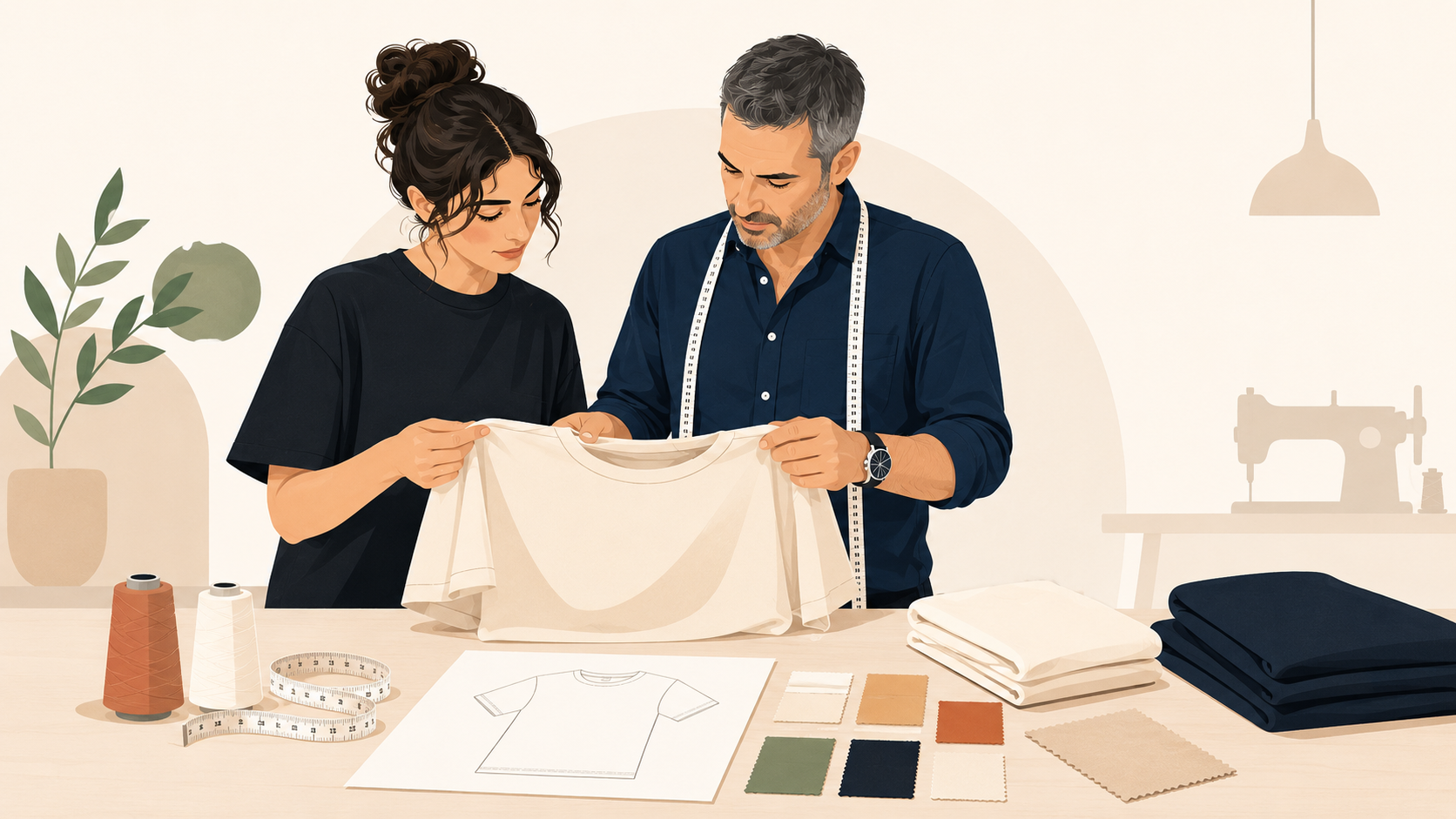
Starting a clothing brand takes more than attractive designs. A successful launch connects a customer need with a focused product, viable pricing, reliable production, and a plan for reaching buyers. This guide explains how to move from concept to a first production order.
1. Define Your Clothing Brand Concept and Target Customer
Begin with the customer, not the collection. “Streetwear for everyone” is too broad. Define who will wear the clothing, why existing options disappoint them, where they shop, what they value, and what they can pay.
Write a one-sentence positioning statement:
We make [product] for [specific customer] who wants [main benefit], unlike [current alternative].
Test the concept. Interview potential customers, review competing products and complaints, compare prices, and show early sketches. A waiting list, limited preorder, or small run of customized blanks can measure demand before you fund custom development. The U.S. Small Business Administration’s market-research guidance provides a useful framework for examining demand, market size, saturation, and pricing.
2. Build a Clothing Brand Business Plan and Budget
You do not need a long investor document, but you do need financial discipline. A useful clothing brand business plan should identify:
- target customer and sales channel;
- first products and their competitive advantage;
- expected retail and wholesale prices;
- development, production, marketing, and operating costs;
- launch schedule and sales assumptions;
- cash needed before revenue arrives.
Calculate the landed cost, not only the factory price. Include samples, labels, packaging, inspections, freight, duties, payment fees, fulfilment, returns, photography, website costs, and marketing. Your selling price must cover these costs, overhead, and future growth. Add a contingency and preserve cash for customer acquisition and reorders instead of putting the entire budget into inventory.
3. Protect the Name and Establish the Business
Before ordering labels or packaging, check whether the brand name is available in your target markets. Search company registers, domain names, social platforms, and relevant trademark databases. The USPTO recommends searching for similar trademarks as part of a clearance search before applying in the United States. Availability in one database or country does not guarantee rights elsewhere, so obtain qualified legal advice when protection is important.
Register the appropriate business entity, arrange bookkeeping, and understand tax and consumer-protection obligations where you sell. Prepare shipping, returns, privacy, and sales policies based on the applicable rules rather than copying another store.
4. Choose the Right Clothing Production Model
Your product and budget determine the production route.
Customized blank garments
Select an existing garment and add printing, embroidery, labels, or packaging. Faster development and lower design risk make this useful for testing an audience or launching a graphics-led brand. Aratex’s apparel product catalog can help you explore base garments.
Private-label clothing
A manufacturer produces an existing or adapted style under your brand. This can offer more control than standard blanks with less development than a fully original garment. Confirm which elements can actually be changed.
Custom cut-and-sew production
A garment is developed from your specifications. This offers the most control over fit, material, construction, and details, but requires more sampling, technical input, and capital. Choose it when the product itself is central to your advantage.
5. Design a Focused First Collection
A large collection multiplies fabric commitments, sample rounds, size combinations, photos, inventory, and opportunities for error. Start with one hero product or a small group of related styles. Limit colors and use shared fabrics or trims where possible.
Decide each style’s intended fit, size range, fabric composition and weight, color, construction, branding method, and target price before requesting quotations.
Create a tech pack for each custom garment. It should include technical drawings, measurement points and tolerances, a size chart, material and trim specifications, stitch and seam details, artwork files and placements, labels, and packaging instructions. A mood board communicates aesthetic direction; a tech pack communicates what must be manufactured.
6. Find and Evaluate a Clothing Manufacturer
Look for relevant product experience, suitable machinery, clear communication, and an understandable quality process. Provide the garment type, specifications, quantities, size breakdown, colors, fabric requirements, artwork, destination, and desired delivery date.
Ask each potential partner:
- What services are included—patternmaking, sourcing, sampling, printing, embroidery, labels, packaging, and shipping?
- What is the minimum order quantity, and does it apply per style, color, or fabric?
- What affects the quoted price?
- How many sample stages are expected, and what does each revision cost?
- When does the production lead time begin?
- How is quality checked, and is any work subcontracted?
- Can the factory provide documentation for certifications or claims you require?
Responsible sourcing should be part of supplier evaluation. The OECD’s garment and footwear due-diligence guidance helps companies address labour, human-rights, environmental, and integrity risks. If material safety matters, understand the evidence: OEKO-TEX STANDARD 100 covers textiles tested for harmful substances, but certification should be verified for the relevant material or article.
7. Develop, Test, and Approve Garment Samples
Sampling converts a design into a production standard. It may include a prototype, fit sample, size set, decoration strike-off, and pre-production sample.
Check measurements, movement, seam quality, fabric feel, opacity, shrinkage, colorfastness, decoration placement, labels, and wash performance. Consolidate feedback into one document, update the tech pack, and request another sample when a change affects fit or construction.
Do not approve bulk production from a digital mock-up. Sign off on a physical pre-production sample made as closely as possible with final fabric, trims, colors, construction, and branding. Keep that sample and the dated specifications as references for apparel quality control.
8. Plan Your First Clothing Production Run
Before placing the order, confirm the quotation, payment terms, quantities by size and color, approved sample, measurement tolerances, packaging, inspection method, production schedule, shipping terms, and responsibility for duties or taxes.
Treat minimum order quantity (MOQ) as an inventory decision, not merely a factory requirement. Base the size curve on customer evidence and avoid splitting a small order across too many variants. Reserve budget for quality checks, freight, launch activities, and reorders.
Design labels for the destination market. In the United States, the Federal Trade Commission explains apparel labelling requirements, including fibre content, origin, business identity, and care information. In the EU, textile products must generally display fibre composition as outlined by Your Europe’s textile-labelling guidance. Verify all market-specific requirements.
9. Prepare the Launch Before Inventory Arrives
While production runs, finalize product pages, photography, size guidance, packaging, fulfilment, email flows, customer service, and launch content.
Set measurable targets: email sign-ups, conversion rate, average order value, return reasons, sell-through by size, and customer-acquisition cost. After launch, use this evidence to decide what to reorder, change, or discontinue. A disciplined second order is often more important than an oversized first collection.
Clothing Brand Launch Checklist
Before committing to bulk production, confirm that you have:
- a defined customer and validated product concept;
- a realistic landed-cost and cash-flow budget;
- a cleared brand name and appropriate business setup;
- a focused collection and complete specifications;
- written manufacturer scope, MOQ, price, and timeline;
- approved samples and quality standards;
- compliant labels and packaging for the sales market;
- a sales, fulfilment, and launch plan.
Frequently Asked Questions
How much does it cost to start a clothing brand?
There is no universal figure. Customized blanks require less development capital than original cut-and-sew products. Estimate the full landed cost, setup, store, marketing, fulfilment, returns, and a contingency before choosing the number of styles.
Can I start a clothing brand with no fashion experience?
Yes, but replace missing expertise with capable partners and clear documentation. You may need a manufacturer, patternmaker, technical designer, accountant, or legal adviser. Never authorize bulk production based on assumptions.
How many designs should a new clothing brand launch with?
There is no fixed number. One strong product or a small capsule is often easier to test, finance, market, and replenish than a broad collection. Add styles when customer evidence justifies the complexity.
Do I need a tech pack to start clothing production?
For a fully custom garment, a tech pack is the clearest way to define the product and control revisions. For customized blanks, the factory may need a simpler specification covering garment choice, quantity, sizes, colors, artwork, placement, labels, and packaging.
Turn Your Clothing Brand Idea Into a Production Plan
Document and test each decision before the next financial commitment. Start with a focused product, understand its true cost, approve a physical sample, and choose a suitable manufacturer.
Aratex is an apparel manufacturer in Artashat, Armenia, supporting brands, businesses, and merchandise projects with blank and custom garments, printing, and production services. Learn more about Aratex’s manufacturing approach, then share your garment type, quantity, specifications, artwork, and target date through the clothing production quote form. For an early-stage question, you can also contact the Aratex team.