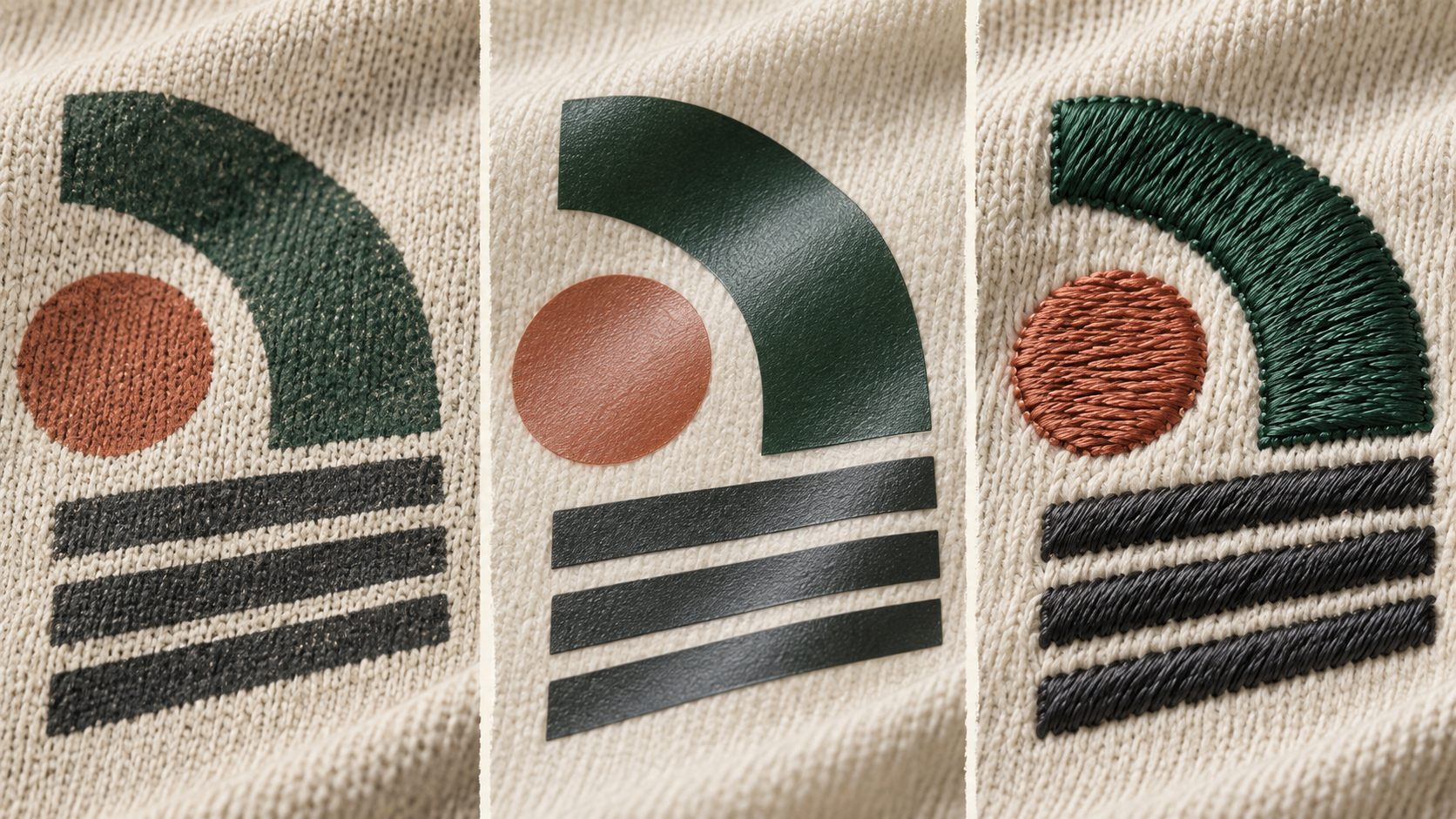
Choosing between screen printing vs DTF vs embroidery affects appearance, hand feel, artwork reproduction, pricing, and fabric compatibility. There is no universal winner: detailed full-colour artwork may suit DTF, a small chest logo can look more premium in embroidery, and a repeated limited-colour graphic may favour screen printing. This guide helps brands and merchandise buyers choose before sampling and production.
Quick Comparison: Screen Printing vs DTF vs Embroidery
| Factor | Screen printing | DTF printing | Embroidery |
|---|---|---|---|
| Best for | Medium and large runs, bold graphics | Detailed, multicolour artwork and smaller runs | Logos, monograms, uniforms, and premium branding |
| Artwork | Strong with solid colours and graphic shapes | Strong with gradients, fine details, and many colours | Strong with simplified, stitch-friendly artwork |
| Fabric compatibility | Excellent on many common garment fabrics when the correct ink is used | Works across many cotton, polyester, and blended fabrics | Best on stable fabrics that can support stitching |
| Feel | Depends on ink and coverage; can be soft or substantial | Smooth transfer layer; larger solid prints feel more noticeable | Textured and dimensional |
| Pricing driver | Number of screens/colours and order size | Print size, ink coverage, and quantity | Stitch count, size, and complexity |
| Small quantities | Often less economical because of setup | Usually efficient | Possible, but digitising adds setup cost |
| Large quantities | Often highly efficient | Practical, though unit economics vary | Suitable for repeat logos; production time rises with stitch count |
Final results depend on the artwork, garment, materials, equipment, and production quality.
What Is Screen Printing?
Screen printing pushes ink through a mesh stencil onto the garment. Each colour normally requires its own screen and production step. The method has significant preparation but becomes efficient when the same design is repeated across a larger order.
Its strengths are strong colour, repeatability, and flexible finishes—from soft prints to opaque graphics. FESPA’s comparison of screen and digital garment printing also highlights screen printing’s value for suitable production runs.
Screen printing is usually best for:
- Medium or high-volume orders using the same design
- Artwork with a limited number of clearly separated colours
- Bold graphics, typography, and brand marks
- T-shirts, hoodies, and merchandise requiring consistent bulk decoration
It is less efficient for low quantities, frequently changing artwork, or designs with many colours and photographic gradients. Pricing depends on screens, colours, ink choice, garment colour, placements, and quantity—not print size alone.
What Is DTF Printing?
DTF stands for direct-to-film. The design is digitally printed onto a specialist film, adhesive powder is applied and cured, and the transfer is bonded to the garment with heat and pressure. Unlike screen printing, DTF does not require a separate screen for every colour.
DTF is useful for small collections, multicolour graphics, and orders containing several designs. It reproduces gradients and fine elements on light or dark garments. Epson’s DTF overview describes its accuracy and flexibility, while its DTF guide explains the film, adhesive, curing, and heat-application workflow.
DTF printing is usually best for:
- Short runs or collections with several different artworks
- Full-colour graphics, gradients, and detailed illustrations
- Fast sampling and product testing
- Cotton, polyester, blends, and other compatible textiles
DTF may be less suitable when a large solid design creates an unwanted transfer-like feel or a garment is heat-sensitive. Negative space can make large graphics more comfortable. Because wash performance depends on materials, curing, and application, approve and wash-test a sample.
What Is Embroidery?
Machine embroidery converts artwork into a digital stitch file and sews the design directly into the garment. Thread gives the decoration texture, depth, and a premium appearance that printing cannot replicate.
Embroidery suits chest logos, caps, polos, jackets, uniforms, and heavyweight sweatshirts. The artwork must be digitised for the fabric, while stitch direction, density, backing, needle, thread, and hooping must work together. Madeira’s embroidery guidance outlines the threads and supporting materials used in machine embroidery.
Embroidery is usually best for:
- Small and medium-sized logos
- Polo shirts, caps, uniforms, jackets, and workwear
- Premium or corporate branding
- Garments that support stitch weight and tension
It is less suitable for gradients, photographic detail, extremely small text, or large dense artwork that becomes stiff and costly. Thin or stretchy fabric can also pucker. Pricing usually reflects stitch count, dimensions, placements, quantity, thread changes, and garment difficulty.
Which Method Is Most Durable?
Embroidery is often chosen for workwear because it is stitched into the garment. Screen printing can also last very well when ink, curing, and fabric are compatible. DTF durability depends heavily on temperature, pressure, curing, and laundering. Rather than declare a universal winner, wash-test the actual sample and follow its care instructions. WRAP’s Extending Clothing Life Protocol offers a broader durability framework.
Which Method Is Cheapest?
- Screen printing often becomes cost-effective as quantity increases because its setup cost is spread across more garments. Adding colours usually adds screens and production steps.
- DTF printing often works well for smaller quantities and multicolour designs because it avoids colour-by-colour screen setup. Price is influenced by print area, coverage, and production volume.
- Embroidery is driven largely by stitch count and machine time. A compact logo may be economical, while a large, dense design can become expensive even if it uses few thread colours.
A useful quote should specify the garment, fabric, quantity, artwork dimensions, placements, designs, and desired technique. Explore Aratex’s apparel product catalogue first, because the base garment affects cost and finish.
How to Choose the Best Garment Decoration Method
1. Start with the artwork
Choose DTF for complex full-colour artwork, screen printing for repeat bold graphics, and embroidery for simplified logos that benefit from texture. Create technique-specific artwork versions when needed.
2. Consider the order quantity
For a small launch with several graphics, DTF may reduce setup barriers. For hundreds of identical limited-colour prints, compare screen printing. Price embroidery using the actual stitch count.
3. Match the method to the garment
Light T-shirts need comfortable, stable decoration. Structured garments often support embroidery well. Always check composition, stretch, coating, seams, and heat sensitivity.
4. Approve a physical sample
Review colour, position, hand feel, edge quality, fabric distortion, and appearance after washing—not only a mock-up. Aratex supports product development and custom apparel manufacturing when brands need to coordinate the garment and decoration.
5. Consider a mixed-method design
A T-shirt can combine an embroidered chest mark with a DTF back graphic; a hoodie might pair front embroidery with a screen-printed back. Mixed methods can improve hierarchy while controlling cost and comfort.
Practical Recommendations by Project Type
| Project | Recommended starting point | Why |
|---|---|---|
| 30 full-colour launch T-shirts | DTF | Low setup burden and detailed colour reproduction |
| 500 T-shirts with a two-colour graphic | Screen printing | Strong repeatability and better bulk economics |
| Polo shirts with a small company logo | Embroidery | Professional, dimensional finish on stable fabric |
| Hoodies with a small front logo and large back artwork | Embroidery plus DTF or screen printing | Each placement uses the technique that suits it best |
| Personalised names or changing designs | DTF, depending on artwork | Easier variation without preparing screens for every design |
Frequently Asked Questions
Is DTF better than screen printing?
DTF often suits detailed, multicolour, lower-quantity designs; screen printing often suits larger repeat orders and limited-colour graphics. The better option depends on artwork, garment, and quantity.
Is embroidery better than printing for logos?
Embroidery suits compact logos on polos, caps, jackets, and uniforms. Printing may be better for large graphics, fine detail, gradients, or lightweight T-shirts.
Can DTF be applied to any fabric?
DTF works across many textiles, but heat-sensitive, coated, waterproof, stretchy, or textured materials require testing. The transfer system and pressing settings must match the garment.
Can screen printing, DTF, and embroidery be combined?
Yes—for example, an embroidered front logo with a printed back graphic. Sample every placement for appearance, weight, comfort, and wash performance.
Choose the Right Finish with Aratex
The best result begins with the right garment, production-ready artwork, and a method selected for the actual order. Aratex is an apparel manufacturer in Armenia producing blank and custom garments. DTF printing and embroidery are handled in-house, while screen-printing requirements are coordinated with a specialised production partner.
Send the garment type, fabric preference, quantity, artwork files, print dimensions, placements, and delivery requirements through the Aratex quote request form. Our team can review the project, recommend the appropriate decoration method, and define the next steps for sampling and production. You can also explore more apparel manufacturing guides or contact Aratex for assistance.